Late in Calder's year the sky over both poles starts to move. Curtains of green light ripple and fold, their upper edges fringed with red, and for a few weeks the aurora is the finest show on the home world. There are two ways to watch it: from a darkened aircraft flying beneath it, or from Halcyon Station, looking down. I have done both many times, and I still cannot choose.
What lights the sky
Ilyr does not only shine. It also breathes out a constant, thin stream of charged particles, steady on most days and gusty on others, when the star throws off a burst. Calder's magnetic field turns most of that stream aside, but near the poles the field lines dip down into the atmosphere, and there the particles follow them in. They strike the upper air between about 100 and 300 km up, and the air glows.
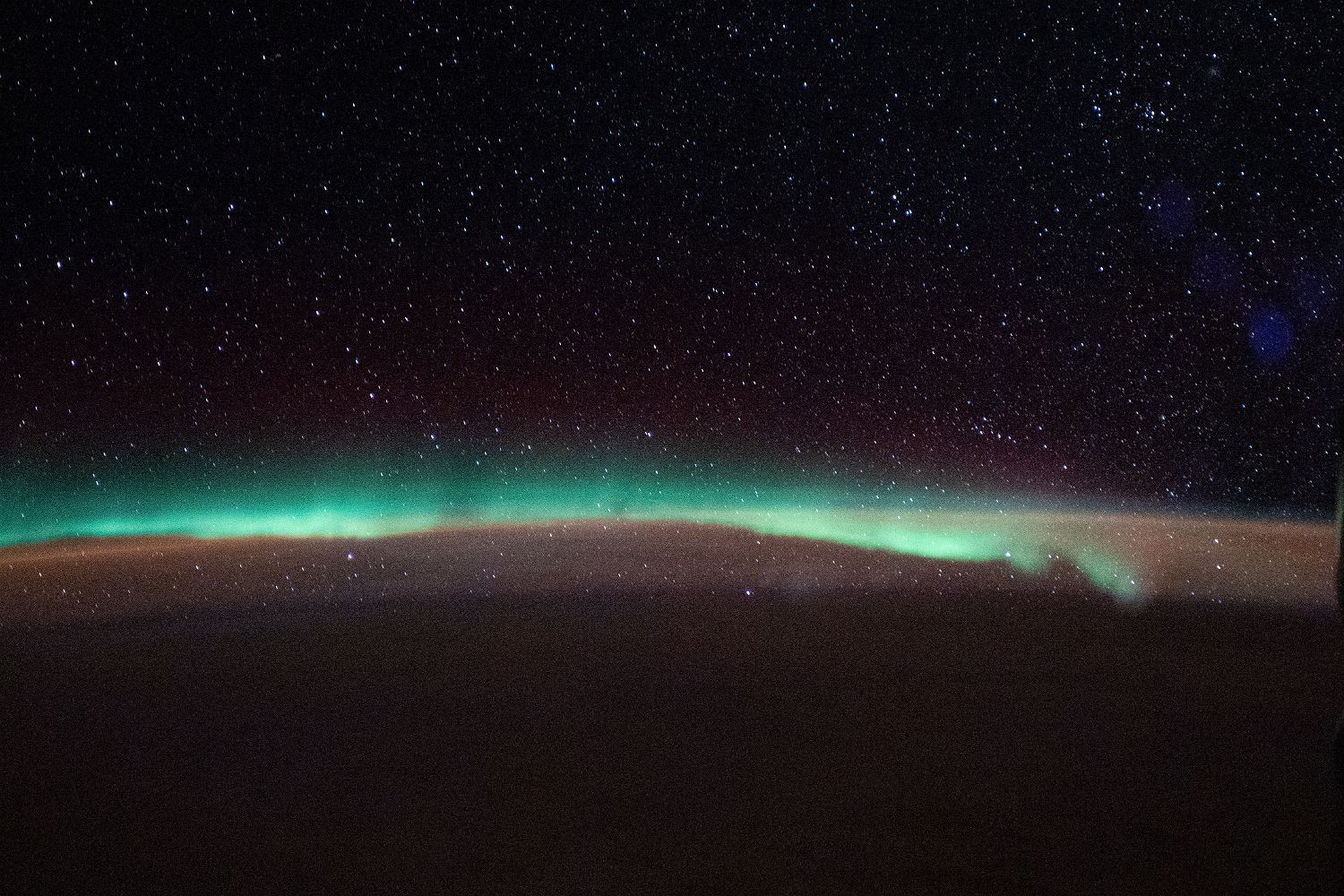
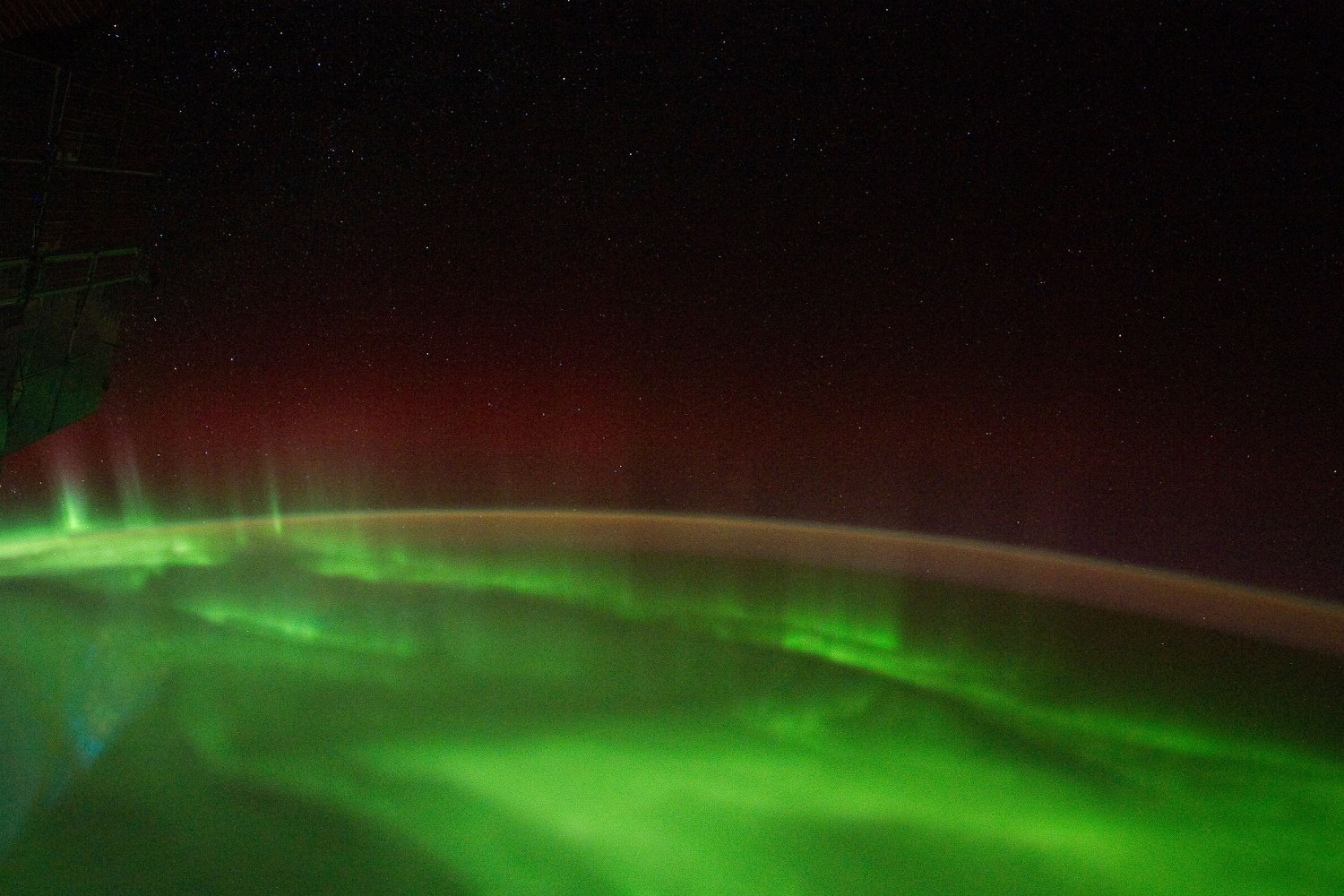
The colours tell you the height. Oxygen in the lower part of that band gives the familiar green, the colour of almost every aurora picture you have seen. Higher up, where the air is thinnest, oxygen glows red instead, which is why the tops of the curtains are fringed with crimson. On strong nights nitrogen adds a pink-violet hem along the bottom edge, and the whole curtain seems to ripple as the incoming stream changes.
The particles arrive in a ring around each pole, not at the pole itself. Seen from below, that ring is an arc across the sky. Seen from above, it is a crown of light lying on the night side of the planet.
Why late in the year
The aurora never entirely stops, but it is not spread evenly through the year. Late in Calder's year, around the turn of the seasons, the planet's magnetic field sits at an angle to Ilyr's stream that lets far more of it in, and the displays at both poles grow brighter and more frequent at the same time. The season lasts about seven weeks. Within it, activity still rises and falls from night to night, depending on what Ilyr is doing, and no forecast more than three days ahead is better than a good guess.
From above you are reading it like a map.
So build in some slack. If you are booking a single flight, book it in the middle weeks of the season. If you are watching from Halcyon, stay at least three nights.
Two ways to see it
From below
Aurora flights leave Port Kestrel in the evening throughout the season. The Kestrel sits on the equator, so the first part of the night is a long run towards the pole; then the aircraft spends about two hours beneath the arc, turning slowly so that both sides of the cabin get their share, before the long flight home. Expect around twelve hours in all.
From below you are inside the display. The curtains hang overhead and ahead, they move faster than you expect, and on a strong night the light is bright enough to read by. The cabin lights go off as you reach the arc. Window seats on the poleward side cost more and are worth it.
From above
From Halcyon's Long Window the aurora is a band of green on Calder's night side, lying close along the curve of the limb, with its red upper layer seen edge-on as a thin glowing line above the planet. On a good night you can follow the arc for thousands of kilometres.
From above you are reading it like a map. The changes are slower and stranger: brightenings that run along the arc like a lit fuse, patches that pulse on and off. There is no flight and no weather, and you can come back every night of your stay.
What to wear and bring
On the flights, cabins are kept cool after dark so the inner window panes stay clear of mist, and you will be sitting still for hours, so bring a warm layer. Wear dark clothes: a pale sleeve reflects in the window and puts a ghost in every picture. Dim your screen to its lowest, or better, put it away; the crew will ask you to in any case.
The Long Window has its own rules: no flash, quiet hours, and the lights kept low along the gallery. Dark clothing helps there too, for the same reason. You will not need binoculars in either place. The aurora is big, and it is best seen whole. A small notebook is more use: people who write down what they saw at the time remember a great deal more of it.
Photographing the aurora
- Focus by hand. Autofocus hunts in the dark. Set the lens to infinity, check it on a bright star, and tape the ring if you can.
- Open up. Use your lens's widest aperture and a high sensitivity, and accept a little grain in exchange for sharpness.
- Keep exposures short. An aircraft vibrates and a station turns. One or two seconds is plenty for a bright display; anything longer blurs the curtains into a green fog.
- Get close to the glass. A soft rubber hood pressed against the window cuts out reflections. Without one, a dark scarf draped over lens and window does the same job.
- Shoot hard, then stop. Take your pictures in the first bright burst, then put the camera down and watch. The best displays rarely last longer than a quarter of an hour, and you will want to have seen them.
Aurora season essentials
- When: late in Calder's year, for about seven weeks
- From below: evening aurora flights from Port Kestrel, about 12 hours in all, two of them under the arc
- From above: Halcyon's Long Window; stay three nights or more
- Colours: green from oxygen low down, red fringes higher up, a pink hem on strong nights
- Wear: warm, dark layers, nothing pale on your sleeves
- Camera: manual focus at infinity, widest aperture, exposures of one or two seconds