Once a year the expedition ship Long Swan leaves Tessaly for Mirren, the frozen world at the outer edge of the Reach. The passage takes about forty days, the stay at Hollin Station a little under three weeks, and the whole voyage, from Tessaly and back, the best part of a hundred days. I had spent nine years looking at ships in dock. I wanted, once, to see what a hull goes through on the longest regular voyage in the Reach.
The long passage
Most of us joined the Swan in orbit at Tessaly, after the usual nine days from Halcyon, and for the first few days the giant and its rings still filled the aft windows. Then they shrank. By the second week Tessaly was a bright, slightly oval star, and Ilyr itself was noticeably smaller and whiter than it looks from Calder. By the fourth week the Lantern, which hangs faintly in the night sky of the outer Reach, had become the most interesting thing in the forward window, and the ship's small telescope was booked from ship's evening until the small hours.
Forty days with nothing outside sounds like a hardship, and the crew are frank that it can be. The Swan's answer is routine. Everyone exercises for an hour a day, no exceptions, because the ship's spin ring is small, the weight it gives is light, and the body needs persuading to stay strong. There are talks most evenings, given by the Hollin researchers travelling out to their posts. There is a workshop where passengers learn to service suit joints and seals, which turned out to be the most popular class aboard, and which proved its worth later.
Life aboard the Long Swan
The Swan is small and built for the job rather than for show. She carries twelve guests, one for each of the guest berths waiting at Hollin Station, along with her crew and whichever researchers are rotating out that year. Cabins are compact; the mess is the centre of the ship; a single observation blister forward seats eight at a squeeze. Water is recycled with a thoroughness you stop noticing after a week. Food is good and plain and, by the last fortnight, largely grown or rehydrated aboard.
The chief engineer let me walk the hull inspections with her, which is not something she offers every guest, and I learned a good deal about how a ship is kept on a voyage this long. Long passages are hard on seals and bearings rather than on plating, and the Swan's crew check every pump and gasket on a rota that runs the full forty days. On day thirty-eight the drive came up for the long burn into Mirren's orbit, and the whole ship hummed for hours. At dinner that evening, for the first time, people talked about the arrival rather than the journey.
Hollin Station
Hollin Station sits on a shelf at the foot of the Hollin Range: a cluster of insulated modules half buried for warmth, a landing pad, a garage of rovers and a long, low common room facing the mountains. It is a research outpost first. Its twelve guest berths are filled once a year, by the Swan's passengers, and for the rest of the year the researchers have the place to themselves. They are generous hosts, and also, after a year alone, very glad of new faces at dinner.
Daylight there is dimmer than you expect and brighter than you fear. Ilyr is a brilliant point rather than a disc, and noon on Mirren is about as bright as a deep dusk on Calder: enough to walk by, enough to read by, never enough to warm anything. Inside, the station is warm, close and friendly, and everyone eats together at one long table.

Ice mountains, nitrogen plains and a sky of haze
The Hollin Range is made of water ice, frozen so hard at these temperatures that it behaves like rock. It holds cliffs, it forms ridges, it cracks into blocks the size of houses. The highest peaks reach about 3 km, and walking their lower slopes in a suit feels like any good mountain day, until you knock on a boulder and remember what it is made of.
Mirren does not look like a destination from there. It looks like a hole in the sky with a halo round it.
Below the mountains lie smooth plains of nitrogen ice, and they are the strangest ground I have ever stood on. Nitrogen ice is soft, as ices go. It flows, very slowly, and over long ages it has filled the low ground and levelled itself into pale fields that stretch to the horizon with barely a ripple. The guides keep visitors to the firm margins, and they are right to.
Above it all is the sky. Mirren's thin air holds layers of blue haze, a dozen or more stacked one above another, each a fine sheet of particles at its own height. At low sun they light up in bands, and the mountains stand against them in stark black and white, as the pictures in our gallery show. After a while you stop looking at the ground at all.
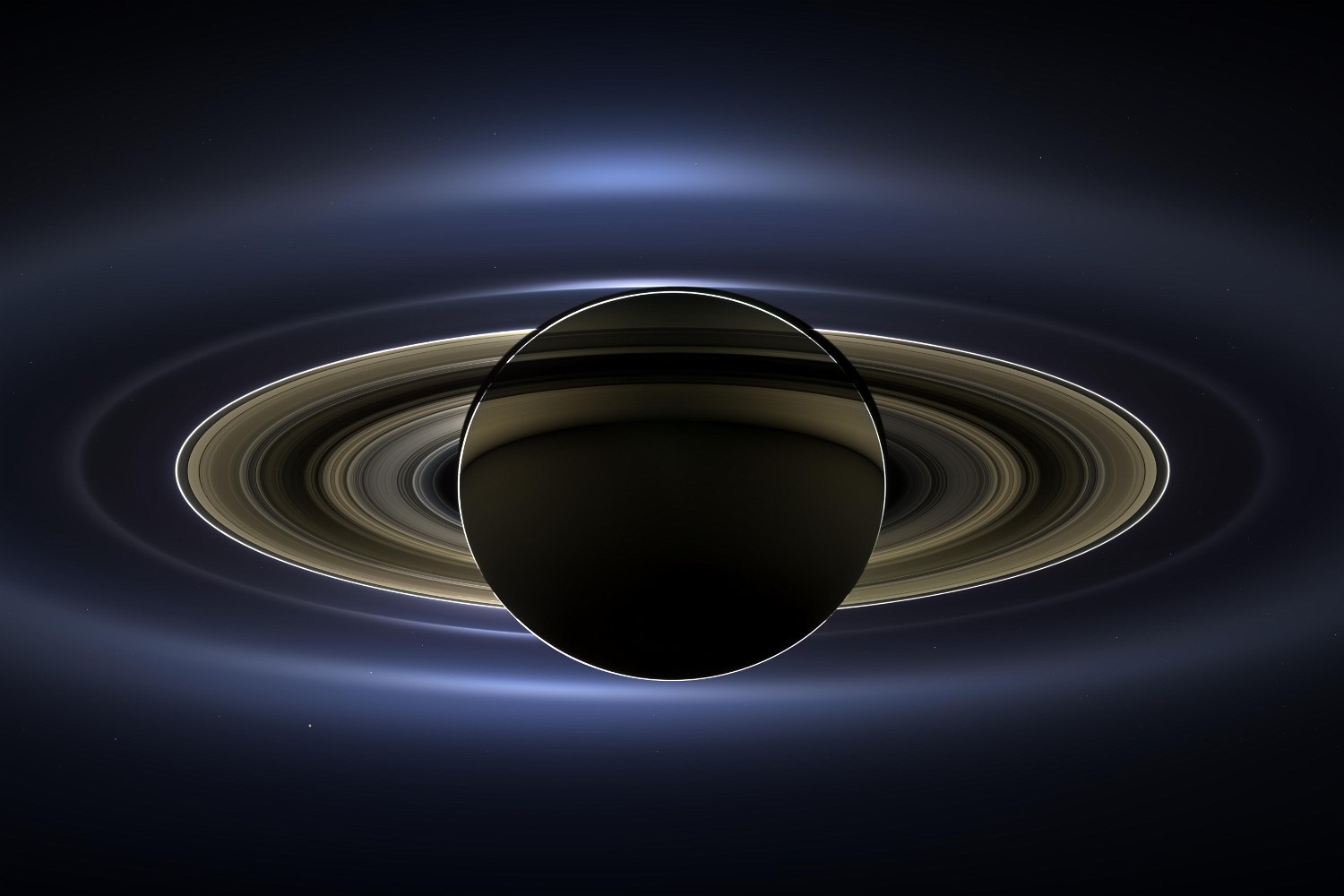
Leaving is the last gift. As the Swan pulls away and turns for home, Mirren slips between the ship and Ilyr, and the whole world becomes a thin dark disc with its haze glowing blue around the rim. Mirren does not look like a destination from there. It looks like a hole in the sky with a halo round it. Then, after a day or two, it looks like nothing at all. Most of us stayed at the windows until it was gone.
The Mirren expedition
- Ship: the Long Swan, one sailing a year
- Passage: about 40 days beyond Tessaly, itself 9 days from Halcyon on the standard transfer
- Guests: 12, one for each guest berth at Hollin Station
- Time at Hollin: a little under three weeks
- Whole voyage: about 100 days from Tessaly and back
- On the ground: the water-ice peaks of the Hollin Range, up to 3 km; smooth plains of nitrogen ice; layers of blue haze
- Before you go: a suit course, and an hour's exercise every day on board