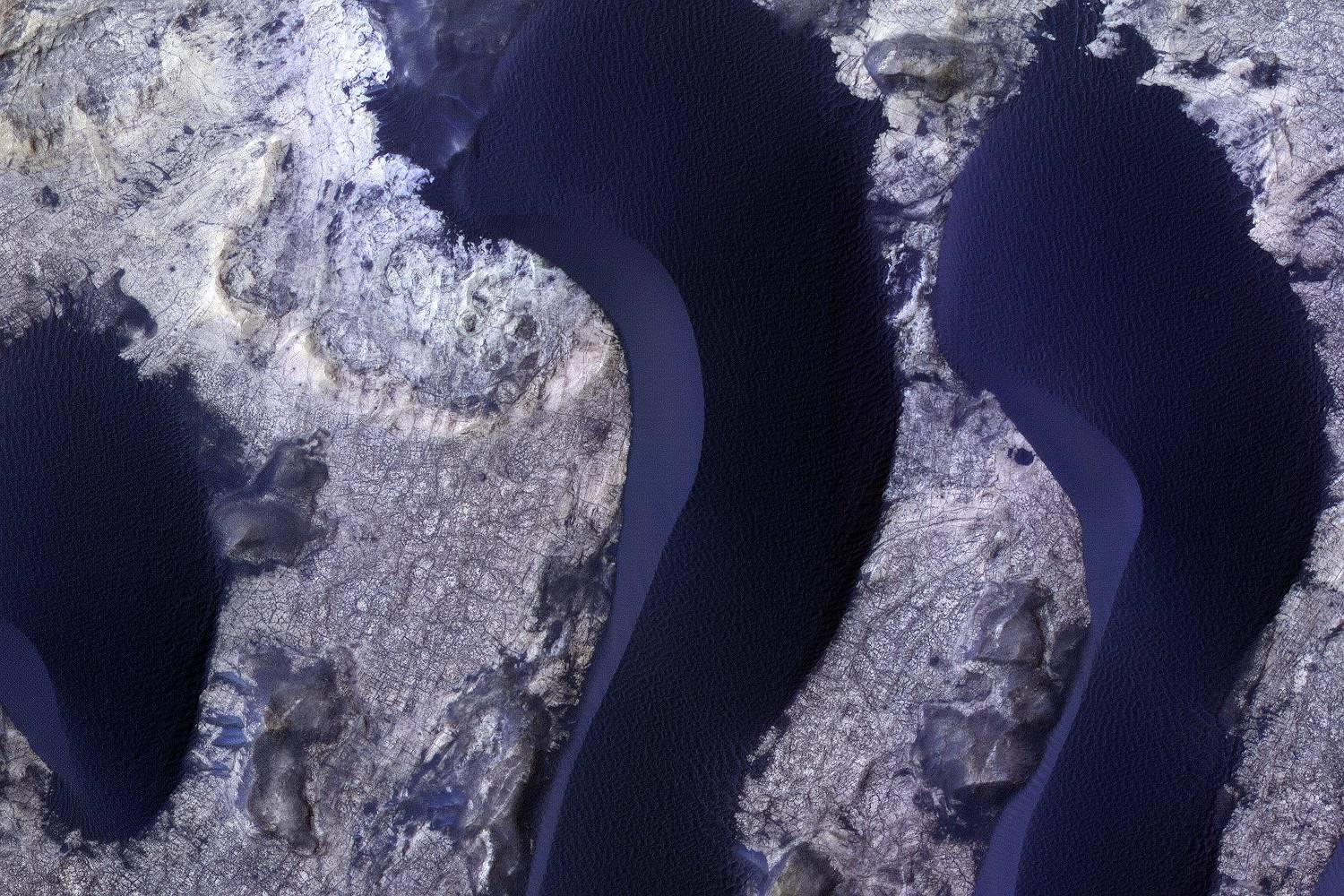
From orbit, the far north of Orrin carries a strange, cool stain across its red: the Blue Erg, a dune sea of dark sand that looks blue-grey in every picture taken from above. Down on it, in a suit, the sand looks almost black, the dunes rise in long, smooth curves, and the walking is some of the best in the Reach. Here is what you need to know before you go.
Why the sand is dark
Most of Orrin is red because it is coated in fine, iron-stained dust. The Erg is different because its sand is basalt: dark volcanic rock, broken down over long ages into grains about the size of table salt. Those grains are much heavier than the red dust. The wind can roll and bounce them along the ground, but it cannot lift them high and carry them off, so over time they have collected in the low northern plains while the fine dust blew on elsewhere.
Underfoot the sand is close to black, with a glitter of tiny greenish crystals when the sun is low. From orbit it reads as blue-grey, partly because of the pale ground between the dunes and partly because you are looking at it through dusty air, which scatters a little blue light of its own. The colour in the pictures is real, in other words, but you will not see it with your boots in it.
How the dunes move
The dunes are not fixed. The wind pushes grains up each dune's long, gentle windward slope and over the crest, where they tumble down the steep lee side, the slip face. Grain by grain, the whole dune walks downwind, a few metres a year. That is slow enough for a map to stay useful for years, and fast enough that the guide companies move their marker beacons every season.
Many of the Erg's dunes are crescents, with their two horns pointing downwind, and where several meet they merge into long, winding ridges. On their flanks and in the flats between them lie ripple fields: ridges a few centimetres high and a hand's width apart, their crests picked out in paler, coarser grains. Ripples are dunes in miniature, and they move far faster. Walk across a ripple field in the morning and your boot prints will be blurred by the afternoon.
Walking on dunes in a suit
Dune walking is tiring anywhere. In a pressure suit it asks for some technique, and your guide will teach it on the first morning. The essentials:
- Walk the windward side and the crests. Windward slopes are firm and gentle. Slip faces are steep, soft and inclined to slide, and a slide in a suit is hard to stop.
- Shorten your stride. Short, flat-footed steps waste less effort in soft sand than long ones, and keep your weight over your boots.
- Use poles. Two poles take some of the work off your legs and catch you when the sand gives way.
- Seal your boots. Basalt grains are hard and sharp, and they find their way into every joint. Fit the gaiters, check the ankle seals at every stop, and brush down thoroughly before you enter a hut lock.
- Drink by the clock. Suits are dry and the walking is warm work. Sip from your suit's water line every twenty minutes, thirsty or not.
- Watch your air. Hard walking uses more of it. Guides set the turn-back time by the slowest walker's supply, never the fastest.
The firmest ground in the Erg is the pale, cracked flats between the dunes, old dried-out hollows baked hard. When your legs are tired, aim for the pale ground. When the guide says no, it is usually because the crust over that particular hollow is thin.
Finding your way
The Erg is the easiest place on Orrin to get lost. Every dune looks like the last, there is no peak on the horizon to steer by, and blowing sand can cut visibility to a few hundred metres within the hour. The guide companies keep lines of marker beacons that show on your suit display, and every walker carries a locator. Learn to read the dunes as well: their slip faces all point the same way, downwind, and once you know which way that is you have a rough compass that keeps working when your display does not.
The rule is simple and absolute. Nobody walks the Erg alone, and nobody leaves the group, not even for a photograph from the next crest.
Guided crossings
Crossings start from Corran, from where a pressurised rover takes most of a day to reach the camp on the Erg's southern edge. The usual choice is between a two-day taster, out and back from the edge camp, and a five-day crossing, with the rover carrying a hut and supplies ahead to each night's stop. Groups are six at most, with a guide for every three walkers. Fitness matters more than experience: if you have walked the Gediz Rim trail, you will manage, and you will sleep very well.
Walking the Blue Erg
- Getting to Orrin: 11 days from Halcyon on the standard crossing, 7 on the express
- Where: Orrin's northern dune seas, most of a day by rover from Corran
- Crossings: a two-day taster or a five-day crossing, groups of up to six
- Sand: dark basalt, near-black underfoot, blue-grey from orbit
- Dune speed: a few metres a year; ripples shift within hours
- Bring: suit gaiters, two poles, a spare seal kit
- Rules: never alone, never down a slip face, back by the turn-back time