Ask anyone who has stood on Veyra's dark side what the Lantern looks like and you will get two answers. The first, honest one: a pale smudge, wider than your outstretched hand, that you are never entirely sure you are seeing. The second comes held out on a screen: a burst of green, red and blue, threaded with dark lanes and studded with bright knots. Both are true. The distance between them is the whole story of the Lantern.
A cloud lit from within
The Lantern is a nebula, an enormous cloud of gas and dust far beyond the outermost world of the Reach. It is so far away that the light reaching your eye tonight set out long before anyone lived on Calder. Most of the cloud is hydrogen, cold and dark. What makes it shine is the young stars embedded inside it: hot, heavy and fierce, burning through their fuel at a rate that Ilyr, a calm middle-aged star, would find reckless.
Their light does two things. It warms the dust around them until the dust glows with heat, the way a stone left in the sun is warm to the touch after dark. And it tears electrons from the gas, which then gives off light of its own as they are recaptured, the trick behind a lit shop sign. The Lantern is not lit from outside, like a cloud at sunset. It is a lamp with its own flames inside.
Some of those flames are still being lit. In the region called the Nursery, dense knots of gas are collapsing under their own weight, warming as they shrink. In time each will ignite and add its light to the rest, and the cloud that made them will slowly be blown apart by their heat. The Lantern, in other words, is not a fixed thing. It is a process, caught part-way.
It is a lamp with its own flames inside.
Why your eye sees so little
The Lantern is large in the sky but its light is spread thin, and your eye judges a faint object by how bright each patch of it is, not by its total. A glow stretched over that much sky barely registers. Two more things are against you. Below a certain brightness the colour cells in your eye give up and the rod cells take over, and rods are sensitive but colour-blind, which is why every nebula looks grey to the naked eye, however colourful its pictures. And much of the Lantern's light is not visible at all: the warm dust shines in infrared, at wavelengths longer than red, which no eye can see.
A camera behind a telescope has none of those limits. It can gather light for hours, adding faint glow to faint glow, and it can be built to see in infrared. Brightwater's telescopes are built for exactly that, which is why their pictures look nothing like the view from the terrace.
Reading the false colours
Infrared has no colour of its own, so any picture made in it has to be given one. The convention at Brightwater is simple, and once you know it the pictures become maps rather than decorations.
Brightwater's colour key
- Green: warm dust, heated by the stars nearby
- Red: the hottest glowing gas, where young stars are fiercest
- Blue: starlight, from stars in and behind the cloud
- White: all three at once, usually a cluster at work
- Black: cold, thick dust that hides whatever lies behind it
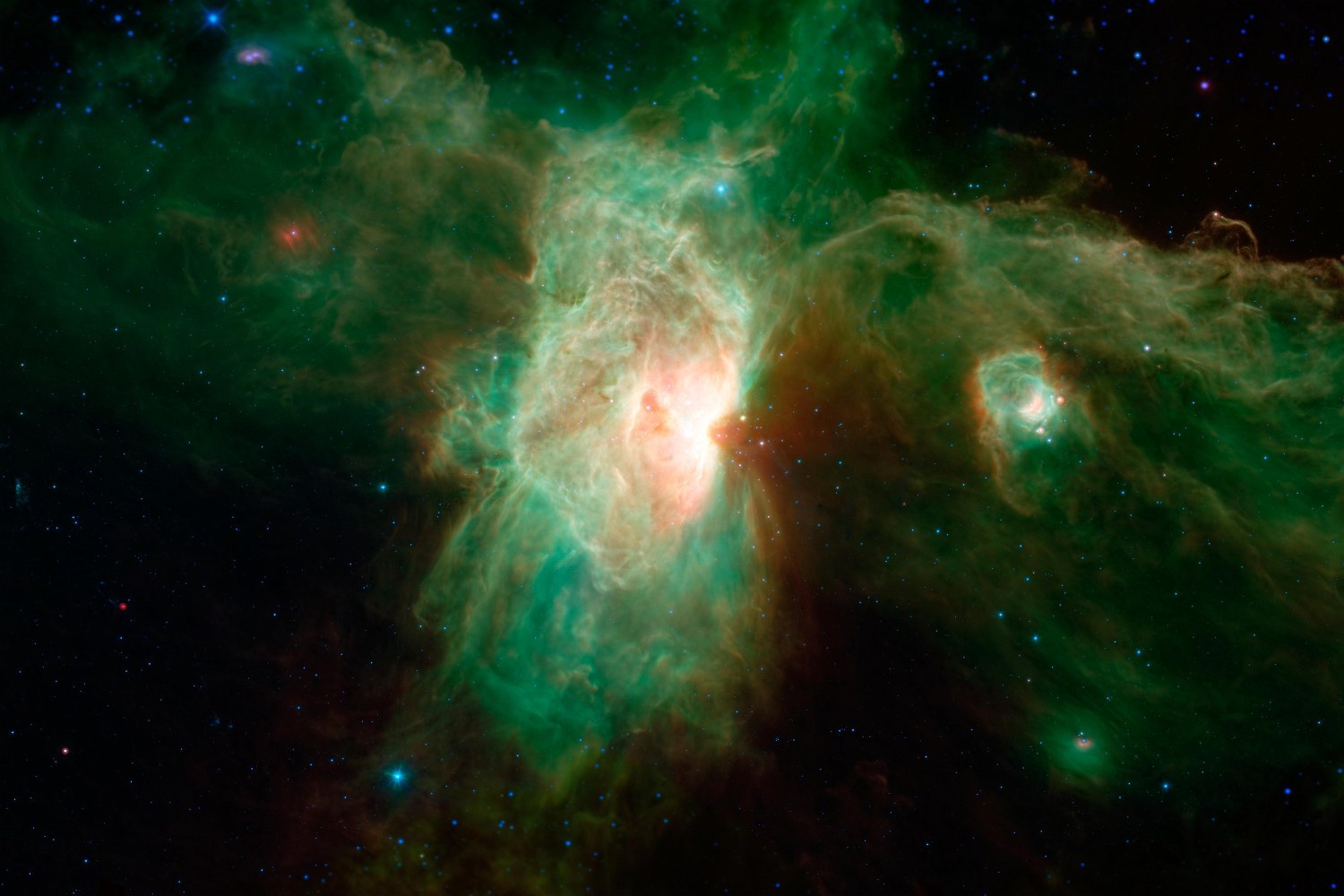
So the green cloud wrapped around a bright white core in the picture above is a shell of dust warmed by a cluster at its heart. The dark lanes cutting across it are not empty space but dust so cold and dense that nothing behind it shows through. None of these colours is what you would see if you could fly there. They are a translation, and a faithful one: every point in the picture is a measurement.
The regions, briefly
The Lantern's parts were named by observers long before Brightwater existed, and you will hear the names on any Lantern night. A quick introduction:
- The Veil: the faint outer shell, a wide, thin curtain that shows only in long exposures.
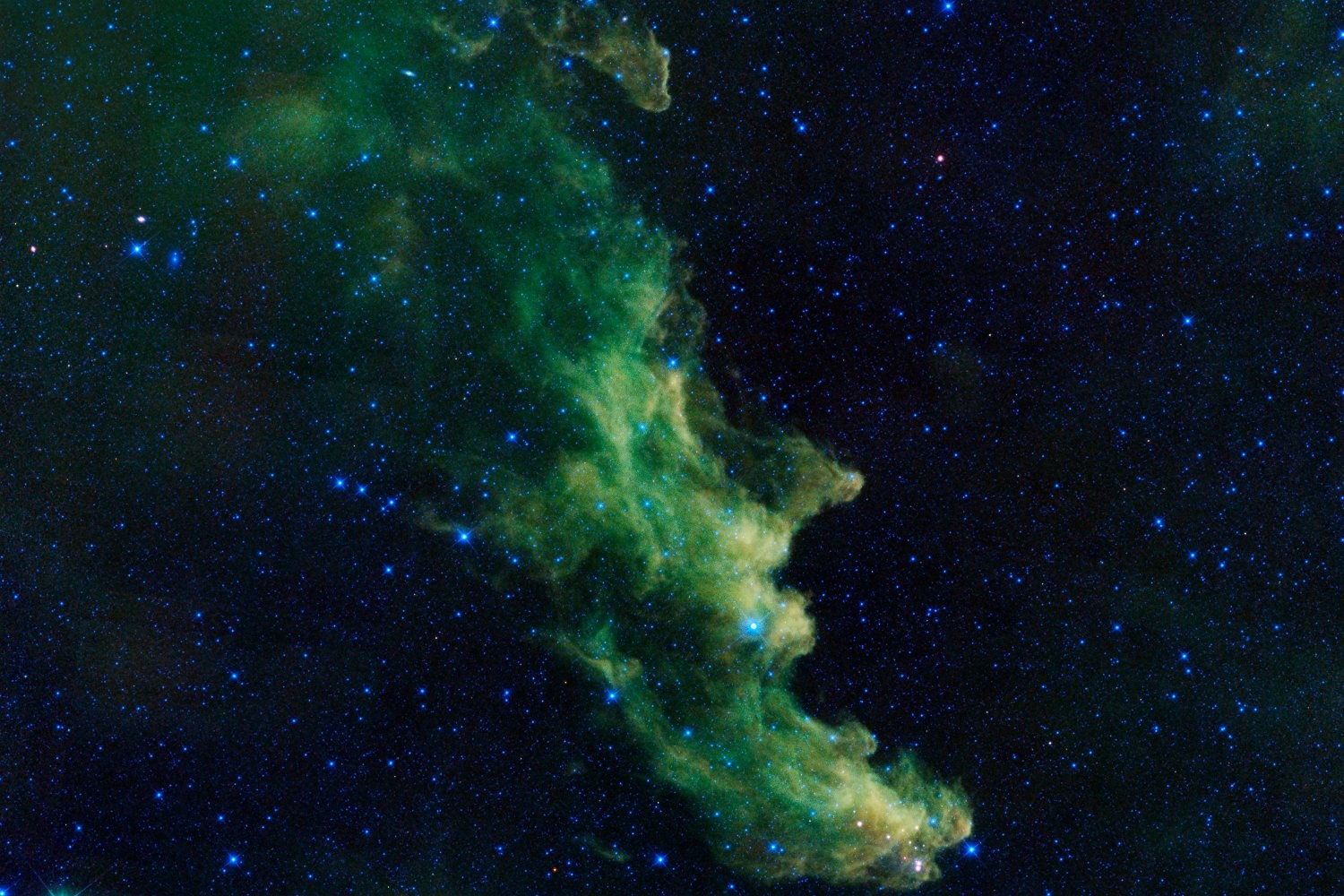
- The Witch: a long green profile along one flank, with a hooked nose if you are generous.
- The Reef: a tangle of blue, orange and red, where glowing gas and warm dust overlap.
- The Wing: a long green cloud with a bright red head, like a bird in a dive.
- The Twin Fires: two bright clusters glowing white and green inside red dust.
- The Nursery: where stars are still forming, dotted with bright knots.
- The Butterfly: a red cloud of glowing gas with two spread lobes.
Where and when to see it
From Calder the Lantern is little more than a rumour. On the darkest nights, far from any town, a few keen observers claim to see it, but the air and the glow of the cities do the rest. Selka is airless and its sky is black even by day, yet Calder hangs in it, bright enough to cast shadows, and drowns the faint stuff.
Out at Tessaly the sky is darker. Ilyr is smaller and weaker, Veyra has no air at all, and Brightwater, on the moon's dark side, schedules its Lantern nights for when the nebula stands highest. After half an hour without a screen or a white lamp, most guests can see it unaided: a grey, faintly mottled glow with a brighter knot at one end. Binoculars show its shape. A telescope shows the Twin Fires as two separate points of light.
Two tips. Use red light only, because a single glance at a bright screen undoes twenty minutes of adapting. And look slightly to one side of the nebula rather than straight at it: the edge of your vision is more sensitive than its centre. Then, when you have seen the real thing, go indoors and look at the pictures. They will mean far more.