On Selka, the first thing you hear is your own breathing. The second is nothing at all. There is no wind on Calder's grey moon, no water and no birds, and when you stand still in the Taurin Valley at midday, under a sky as black as the inside of a pocket, the silence sits on your helmet like a hand. I walked there for three days from Camp Ardent, and I have been trying to describe it to people ever since.
Getting there, and Camp Ardent
The crossing from Halcyon Station takes two days, and ends at a landing field a short rover ride from camp. Camp Ardent is a pressurised hostel of 40 beds, half dug into a low hill: bunk rooms, a canteen with long tables, a suit room that smells of warm fabric and machine oil, and the guides' office, where a board lists every party outside and the time it is due back. Everyone who walks on Selka passes through it. Suits are rented here, guides hired here, and stories told here at night by people whose faces still carry the red line of a helmet seal.
Calder hangs in Selka's sky in the same place for the whole of your stay, blue and white and enormous, while Ilyr crawls so slowly across the black that over three days it barely moves. The camp keeps Port Kestrel time. Without it, you would lose track of the days within hours.
Day one: the suit, and the first steps
The fitting takes most of a morning. Technicians measure your shoulders, torso and hands, then bring the suit in pieces: legs, upper body, helmet, and the gloves, which matter more than anything else. A glove that is too long numbs your fingertips within an hour; one that is too short rubs the knuckles raw. Do not be polite about the fit. After a pressure check in a chamber comes the briefing: about eight hours of air per suit, the radio, the warning tones and what to do about each.
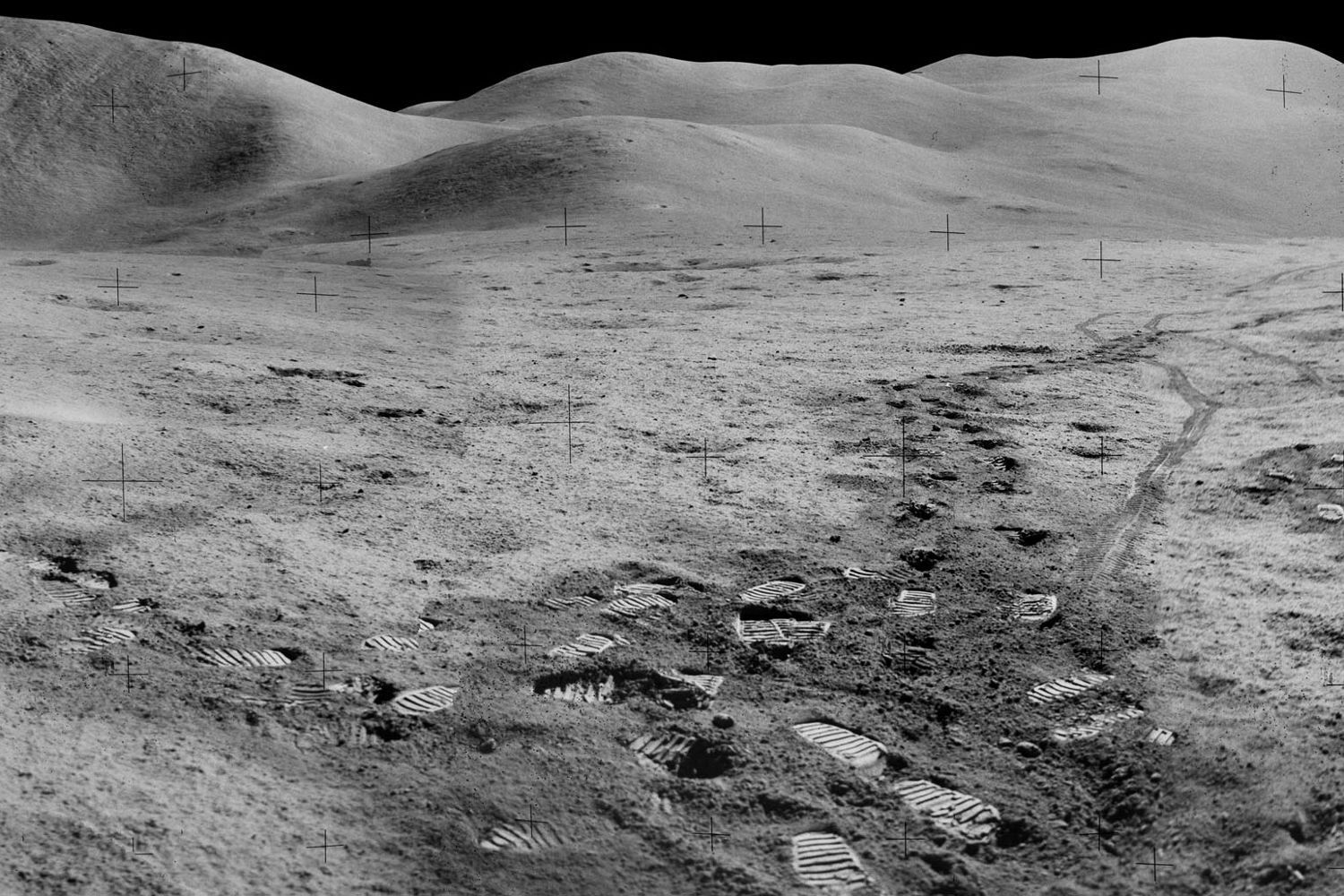
Then the airlock, and the first steps. Selka's gravity is about a sixth of Calder's, and your body has no idea what to do with it. You push off for a step and rise; you plant your foot and slide; you try to stop and keep going. Within half an hour most people find the guides' rolling lope, a sort of slow-motion skip, and start to enjoy themselves. In the afternoon we climbed the ridge behind the camp and looked down at our own tracks, sharp-edged in the grey dust. There is no wind here, and nothing to fill them: the prints you make on your first afternoon will still be there when your grandchildren come.
The prints you make on your first afternoon will still be there when your grandchildren come.
Day two: down into the Taurin Valley
The Taurin Valley is a broad trough of rolling grey hills, their outlines softened by ages of tiny impacts, a few hours' walk from camp. Our guide, a former survey technician named Pell Arandt, set an easy pace and stopped often. On Selka you need the stops. With no air to scatter the light, every shadow is pitch black, and a step into your own shadow can hide the ground completely. Distances are just as tricky. The horizon is close on so small a moon, and a hill that looks a short stroll away may take an hour to reach.
The colours are subtler than the pictures suggest. The dust is grey at noon, but in the low light near the valley floor it takes on a faint warm brown, and the old rover tracks from the survey years run across it in long double lines, as crisp as the day they were laid. Pell pointed out a set of boot prints by the trail and told us they were older than Camp Ardent. Nobody spoke for a while after that.
Lunch, such as it is, comes through a tube in your helmet: a sweet, thick drink that tastes better than it sounds after five hours of walking. By the time we were back at the airlock my thighs ached from all that bouncing, and I slept as well as I have anywhere.
Day three: the Sixth Station boulder
The last day's walk climbs a long grey slope to the Sixth Station boulder, named for the sixth of the old survey markers set beside it. It is the size of a house, split clean through the middle, and sits alone on the hillside under the black sky. A faint groove runs up the slope above it, the track it left when it rolled down from the ridge long before anyone came to see it. The gap between the two halves is wide enough for two people to stand in side by side. Guides let you step inside, one party at a time, and it is the quietest place I have ever been.
Back at camp, peeling off the suit, I noticed the smell it had brought in from outside, sharp and burnt, like spent matches. That is Selka's dust. It clings to everything and lingers in your nose for a day, and I found I did not mind at all.
Walking Selka
- From Halcyon Station: 2 days
- Camp Ardent: 40 beds, pressurised; book well ahead
- Gravity: about a sixth of Calder's
- Suits are rented at the camp; allow half a day for the fitting
- Suit air: about 8 hours, so plan each day around it
- Guides are hired at the camp; nobody walks beyond the ridge without one
- Bring: thin liner gloves, soft socks, lip balm for the dry air indoors