Every few weeks a letter reaches this magazine asking, more or less politely, why the crossing from Halcyon to Tessaly takes nine days when the liners have fusion drives and the giant, on a clear night, looks close enough to touch. The short answer is fuel. The longer answer is one of the most elegant ideas in travel, and it explains the timetable, the fares and the view from your cabin window.
The three-day crossing nobody flies
Suppose you point a liner at Tessaly and run the drive the whole way: accelerate for half the journey, turn round and brake for the other half. A modern ship could do it in about three days. The trouble is the bill. To halve the time of a journey you must roughly double your top speed, and then shed all of it again before you arrive. Worse, the propellant needed does not grow in step with the speed but much faster, because every tonne you burn early on has had to carry, and push, all the tonnes you have not burned yet.
Run the numbers and a three-day ship would need tanks larger than its cabins, and tickets priced like a small house. Nobody builds one. Instead, the liners borrow a trick from the worlds themselves.
Falling around Ilyr
Calder, Tessaly and everything else in the Reach are falling around Ilyr all the time, moving sideways fast enough that they never fall in. A liner leaving Halcyon is already doing the same, carried along at Calder's speed. It burns its drive hard for a few hours, which lifts it from Calder's path into a wider, oval one, and then the drive goes quiet and the ship coasts. It is still circling Ilyr, but on an orbit whose far end touches Tessaly's. Days later, at that point, it burns again to match the giant's speed and slips into orbit around it.
The coast costs nothing. That is the elegance of it: most of the crossing is free, paid for by the push at the start. It is also why the journey takes nine days rather than three. A ship that is coasting is not speeding up, and the curved path is longer than the straight line it replaces.
Most of the crossing is free, paid for by the push at the start.
The catch is timing. Tessaly has to be at the meeting point when the liner gets there, so a ship can leave only when Calder and Tessaly stand in the right arrangement. They come back into it every 26 days. Miss a window and you wait for the next one, which is why the departures gallery on Halcyon is crowded around each window and quiet in between.
Standard or express?
Both kinds of crossing fall around Ilyr. The difference is how hard they push.
Standard transfer
About nine days from Halcyon to Tessaly orbit.
- Short burns at each end, a long free coast between
- Cabins on spinning rings for almost the whole trip
- The fare most travellers pay
- Departures in every 26-day window
Express
About six days, on a steeper, faster path.
- Longer burns, roughly three times the propellant
- Fewer passengers and less cargo per sailing
- Fares around two and a half times the standard
- The same 26-day windows: speed does not free you from them
Most of the express's extra cost is paid at the far end. A ship that arrives fast must brake hard, and braking takes as much propellant as speeding up did, so the express carries fuel for both and has less room for anything else. That is the real price of the three days you save: not the drive, but everything the ship could have carried instead.
Is the express worth it? For a business trip, perhaps. For a holiday, the three days you save are three days of the best part of the journey: the coast, with nothing to do but read, eat and watch the giant grow.
What you see on the way
For the first day, Calder dominates the view astern, a blue-white disc shrinking hour by hour, with Halcyon a moving spark beside it and Selka a grey bead further off. Then the home world becomes a bright star, and Ilyr is the only large thing in the sky. It too grows a little smaller each day as you climb outward, and the light through the sunward windows turns noticeably paler.
By the fourth day Tessaly is the brightest point ahead, and with binoculars you can see that it is not quite round: the rings stretch it sideways. By the sixth it is a disc, banded and pale gold, and its moons show as points strung along the ring plane. On the last day it fills the window, the crew calls everyone to their seats for the braking burn, and for a few hours the floor seems to tilt as the drive adds its push to the ring's spin.
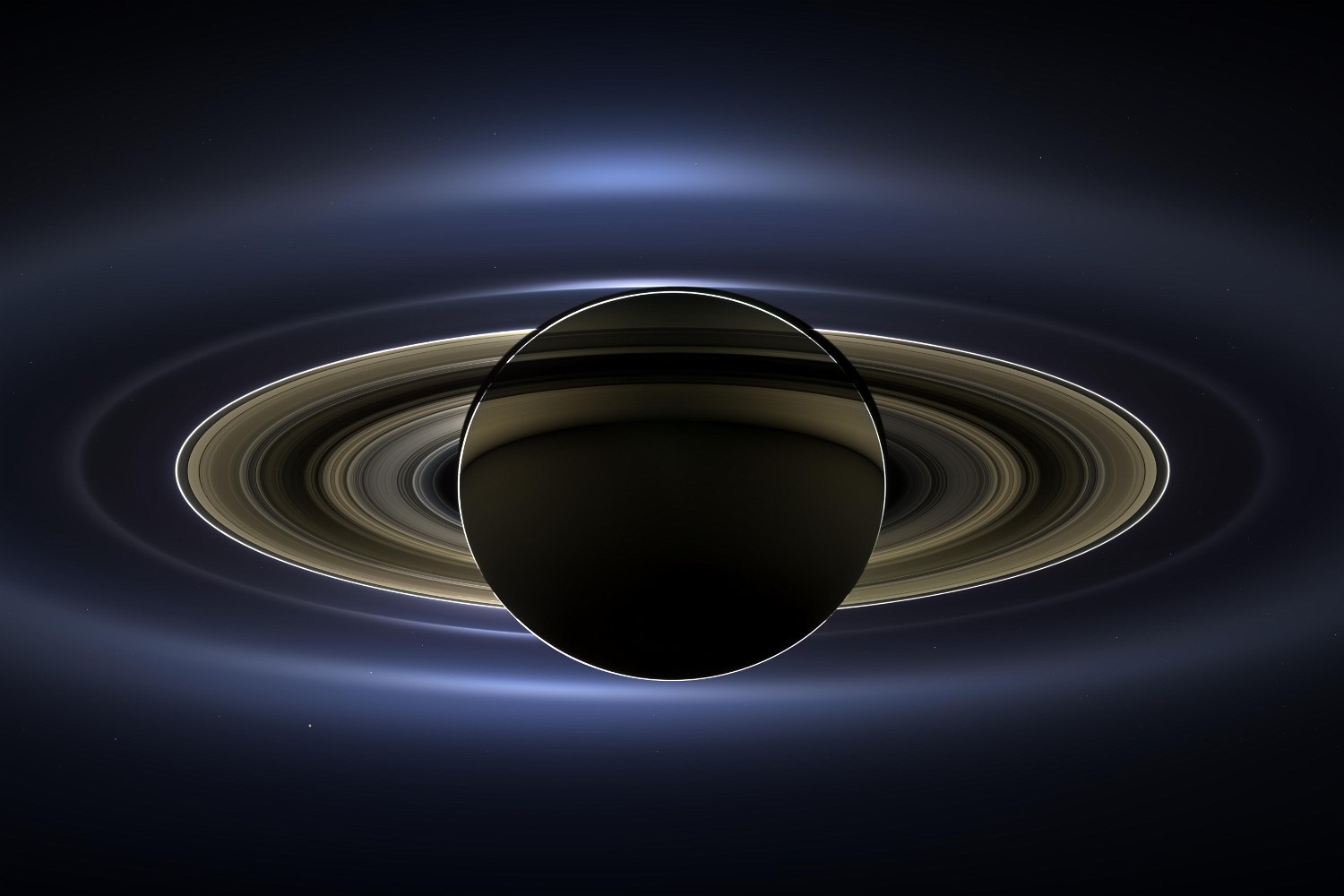
Time your crossing near Tessaly's equinox and the rings will be nearly edge-on when you arrive, a thin bright line drawn across the planet's face, as in the picture above. It is a reminder of how thin those rings are, and of how far you have come, for free, by falling.