Of all the sights in the Reach, the Rose is the one most often called impossible. A storm thousands of kilometres across turns at the top of Tessaly, and around it, like a frame around a painting, runs a jet stream with six straight sides. Nature does not do straight lines, people say. Here it does, and it has been doing so for as long as anyone has looked. As a geologist I was trained to distrust anything that looks too tidy. The Rose is tidy, and it is real.
A storm at the top of the world
The Rose is a polar vortex: a vast, long-lived storm sitting exactly on Tessaly's north pole. Its eye is about 2,000 km across, and its spiral arms reach far beyond that, winding inward towards a centre where the clouds dip deep into the planet. At the eye wall the winds run at several hundred kilometres an hour.
Storms on Calder are born over warm water and die when they reach land or cool sea. The Rose has neither to stop it. Tessaly has no surface, only deeper and denser layers of gas, and nothing beneath the storm to drag on it. The planet spins fast, once every 10.5 hours or so, and that spin, together with the heat rising from deep inside the giant, keeps the storm fed. Nobody knows how old the Rose is. Every record of Tessaly's pole shows it there.
Why six sides
Further from the pole, a narrow river of wind races around the planet: a jet stream. On most worlds a jet like this wanders in loose, shifting loops. Tessaly's settles into a hexagon, each side about 14,000 km long, and holds it.
The reason lies in the difference in speed. The jet is a fast stream with slower air on either side, and wherever fast fluid runs beside slow, waves form along the boundary, as they do where a quick river meets still water. Under the right conditions, set by the jet's speed, its width and the planet's spin, those waves lock into a pattern that stays fixed in place, with a fixed number of crests. Tessaly's numbers give six.
Nature does not do straight lines, people say. Here it does.
You can watch the same thing happen in a laboratory. Fill a shallow tank with water on a turntable, spin a ring at its centre a little faster than the rest, add dye, and polygons appear in the swirl: three sides, four, five, six, more, depending on the speeds. Students at Port Kestrel do it in a morning. It never stops being strange.
The hexagon also keeps time. It turns with the deep interior of the planet, steadily, while the clouds elsewhere drift with the winds, and its turning is one of the ways astronomers worked out the length of a Tessaly day.
Why the pictures are not what you will see
The famous image of the Rose, a deep-red spiral in a sea of green cloud, is false colour. It is made in infrared, through filters tuned to wavelengths that the gases of Tessaly's atmosphere partly absorb. Light reflected from deep clouds has to pass through more gas on its way out, so it arrives dimmer in those bands than light from high clouds. Each colour in the picture, in other words, stands for a height. In the usual convention red marks the deep cloud seen down the throat of the storm, and green the high haze all around it.
Such pictures are maps of the storm's shape in three dimensions, which is why scientists love them. They are not a promise of what the window will show.
To the eye, from a liner, the Rose is subtler: soft gold and cream with grey-blue shadows, the eye a darker well at the centre, the spiral clear in binoculars. The hexagon shows as a faint change of tone along its edges, easiest to see when Ilyr is low over the pole and the cloud tops cast long shadows.
Lining up the view
Most liners arrive at Tessaly in the plane of its rings, heading for Veyra and the other moons, and from there the pole is seen at a steep slant, if at all. Sailings that offer the Rose make a polar pass. They shape the braking burn so that the arrival orbit swings high over the north, at the cost of a few extra hours and a little extra propellant, which is why the pass usually carries a surcharge. The best of the view lasts a few hours around the high point of that orbit, with the pole almost directly below.
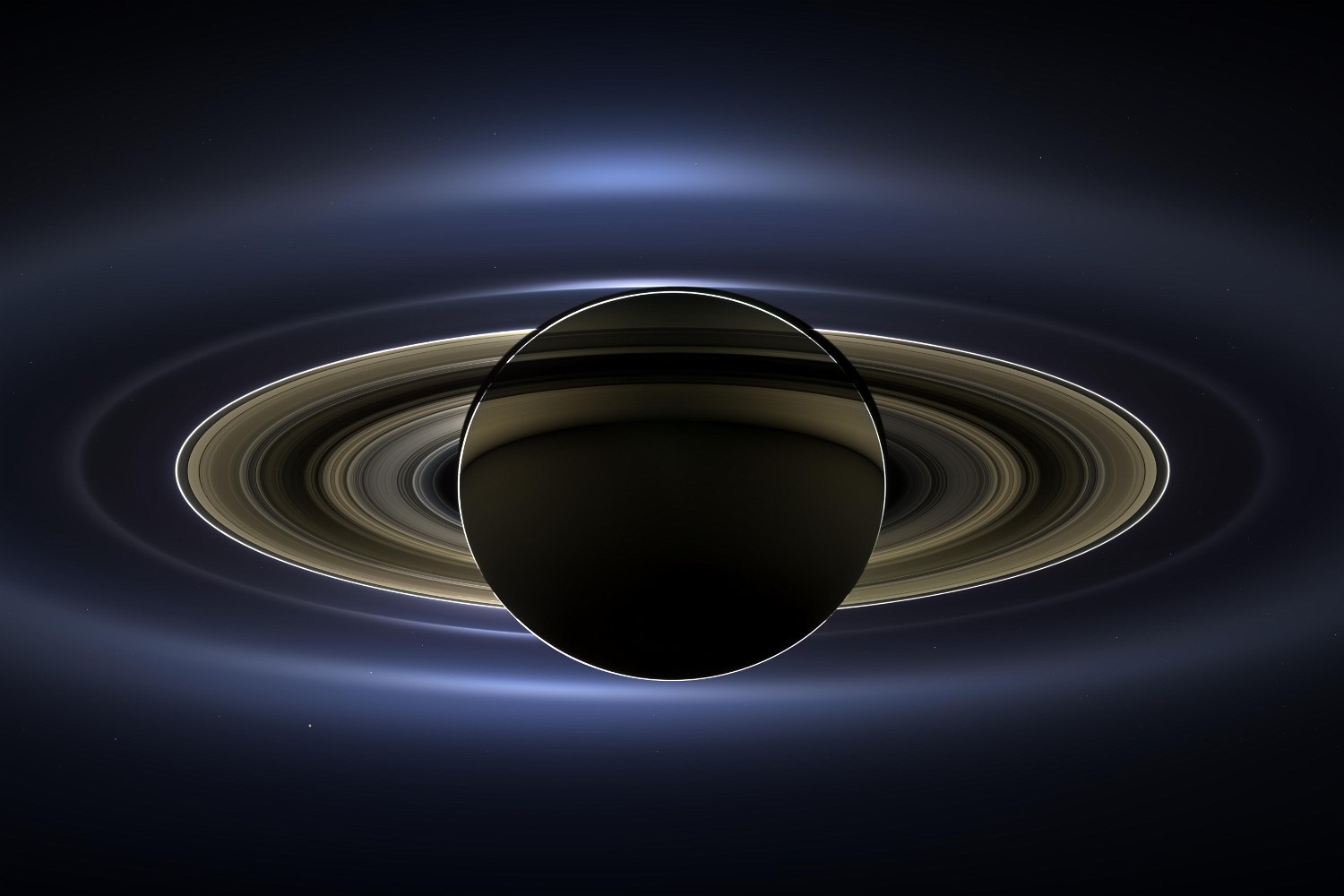
Season matters too. The Rose must be in sunlight to be seen at all, and during the long northern winter it sits in darkness. Near equinox, when the rings go edge-on, Ilyr skims the horizon at the pole, the light is low and the shadows long, and the hexagon is at its clearest. A pass that also carries the liner through Tessaly's shadow brings a second reward: the giant backlit by Ilyr, its rings glowing like a halo.
Seeing the Rose
- Where: Tessaly's north pole, inside the six-sided jet stream
- Size: the eye about 2,000 km across; each side of the hexagon about 14,000 km
- Best from: a liner's polar pass, a few hours around the high point
- When: whenever the pole is sunlit; the low light near equinox shows the hexagon best
- Bring: binoculars, and patience; the details come slowly