On Orrin the colours of the sky run backwards. Noon is the shade of butterscotch, the horizon a dusty tan, and then, in the last minutes of the day, a cold blue glow gathers around the setting sun like frost on a window. Here is why it happens, and where to stand near Corran when it does.
A sky coloured by dust
On Calder we are used to a blue sky by day and a red one at sunset. Both are the air's doing. The gas scatters short, blue wavelengths far more strongly than long, red ones, so blue light is bounced around the whole dome of the sky, while a low sun, shining through a long slab of atmosphere, loses its blue on the way and turns orange.
Orrin's air is far too thin for that. Travellers wear pressure suits outside for good reason: there is barely enough gas there to scatter anything. What colours Orrin's sky is dust. The wind lifts very fine grains from the plains and canyon floors, most of them smaller than a thousandth of a millimetre, and keeps them aloft for weeks. As a geologist I find them lovely things: flakes of weathered rock stained with iron, the same rust that makes the ground red. They also behave nothing like gas. They absorb a good share of the blue light that reaches them, and they scatter what is left mostly forward, in the direction it was already travelling, rather than out across the sky.
Butterscotch at noon, blue at dusk
At midday the sun is high and its light takes a short path through the dust. The grains soak up blue and spread the warmer colours widely, so the whole sky takes on the pale caramel tone that visitors find either cosy or faintly unsettling. Shadows are sharp, and the ground, already red-brown, looks redder still.
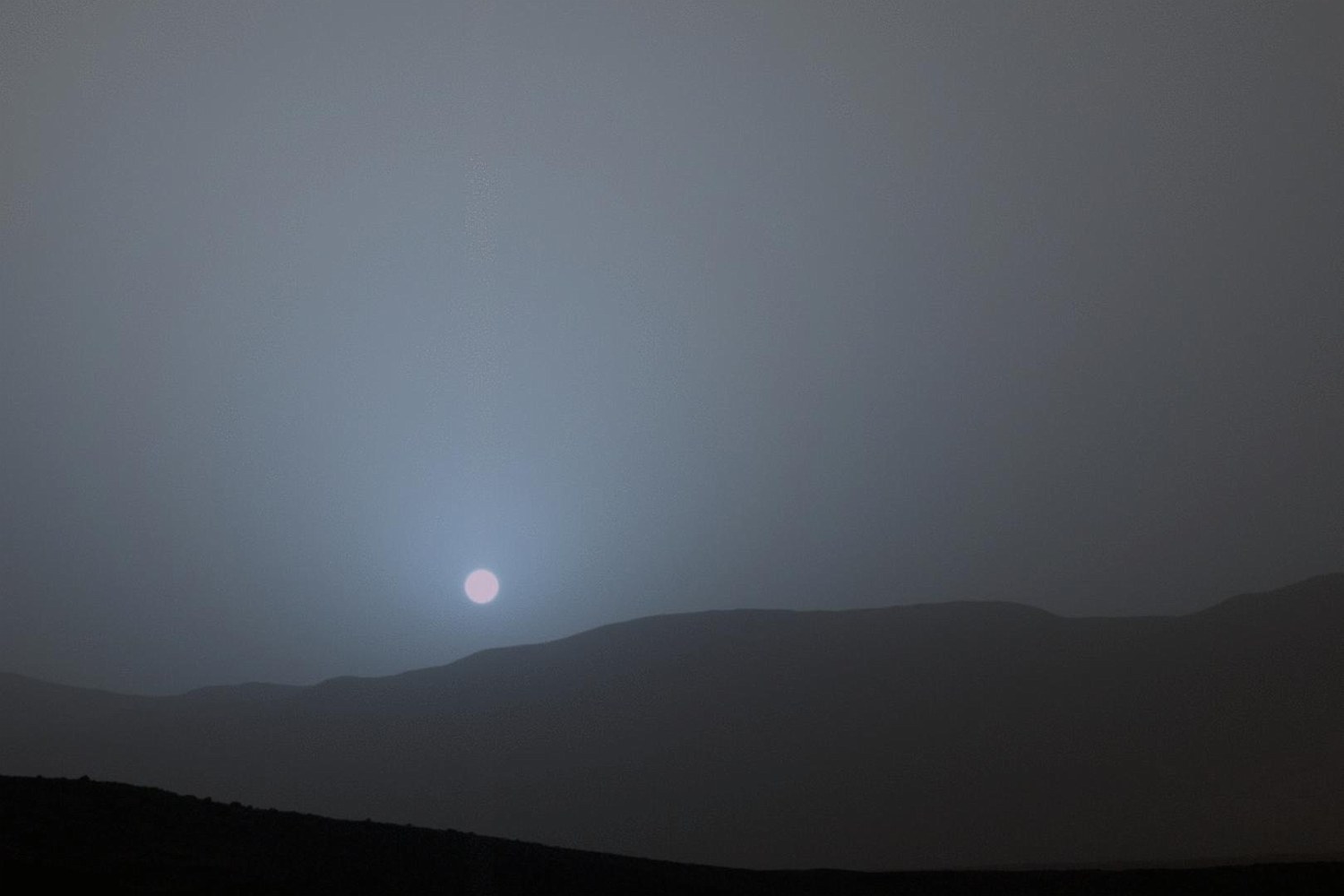
As the sun drops, its light crosses far more dust before it reaches you, and the forward scattering takes over. Blue light, which these grains throw into a tight cone around the direction of the sun, arrives as a glow gathered close around the disc. Away from the sun the sky fades to grey-brown. The effect is strongest in the half hour either side of sunset, and it is not subtle. The small, pale sun sinks inside a halo of blue that can spread to several times its width.
A useful way to remember it: on Calder the blue is everywhere except near the setting sun; on Orrin it is nowhere except near the setting sun. The blue is not the air. It is the dust, and the dust changes from week to week.
That last point matters when you plan. Straight after a dust storm the sky is loaded and the blue is wide, soft and rather washed out. After a long calm, when much of the dust has settled, the glow tightens and deepens. Corran's weather office chalks a daily dust reading on the board beside the main lock; a middling figure, a few days after a storm, tends to give the finest evenings.
Where to watch near Corran
Corran sits on the rim of the Gediz canyon, and near the town the canyon runs roughly east to west. That is a gift to anyone who likes a sunset: on most evenings the sun goes down along it, over the far rim, with the whole depth of the canyon in front of you.
- The west gallery of the dome. No suit, no booking: a bench, a hot drink and a wall of glass. The glass softens the colours a little, but this is the easy first look, and on a clear evening the benches fill an hour before sunset.
- The Weather Steps. A cut ledge twenty minutes' walk from the west lock, past the instrument masts, on a marked path with the canyon dropping away to your left. Suits are required, and so is a companion. This is where the town's photographers go.
- The first trail hut. Walkers on the Gediz Rim trail spend their first night in a pressurised hut that looks straight down the canyon. If you are doing the four-day walk, you get blue hour without leaving the route.
- Bolívar Pass. Further along the trail, the wind-carved sand ridges below the dark layered cliffs catch the last light in long stripes, and the blue glow sits just above them. It is for trail walkers only; there is no quick way out and back.
The small, pale sun sinks inside a halo of blue that can spread to several times its width.
Photographing the blue
Cameras record Orrin's sunsets more honestly than eyes do. Eyes adjust to the colour within minutes and start to see it as ordinary; a sensor never does. It does need some help, though.
- Fix the white balance. Set it to daylight and leave it there. Automatic white balance decides the blue is a mistake and corrects it towards grey, and turns the butterscotch noon sky an unconvincing white.
- Expose for the glow. Take your reading from the bright blue around the sun and let the ridge go black. Most cameras will try to brighten the foreground; give them a stop or two less than they ask for, and take a second frame darker still.
- Mind the visor. A suit's outer sun visor is tinted gold, which turns blue into a muddy green. Raise the sun visor, never the pressure visor beneath it, and rest the lens hood gently against the clear inner visor so that the inside of your helmet does not reflect into the frame. Switch your helmet lamp off first.
- Keep the batteries warm. The cold drains them fast. Carry a spare in an inner pocket of the suit's thermal layer and swap it once you are back inside the lock.
- Use something steady. Gloved hands shake. A small tripod, or the low wall at the Weather Steps, makes a sharp picture far more likely as the light falls.
The blue lingers for twenty minutes or so after the sun has gone, shrinking to a band along the horizon, and some of the best pictures come in those last minutes. Agree a turn-back time with your group before you leave the lock, and keep to it: the path is marked, but it is easier to follow in the light.
Blue hour at a glance
- Best time: the half hour either side of sunset
- Best conditions: a middling dust reading, a few days after a storm
- Easiest view: Corran's west gallery, no suit needed
- Best view: the Weather Steps, 20 minutes from the west lock, suited and in pairs
- Camera: daylight white balance, expose for the glow, gold visor raised
- Bring: a spare battery in an inner pocket, a small tripod